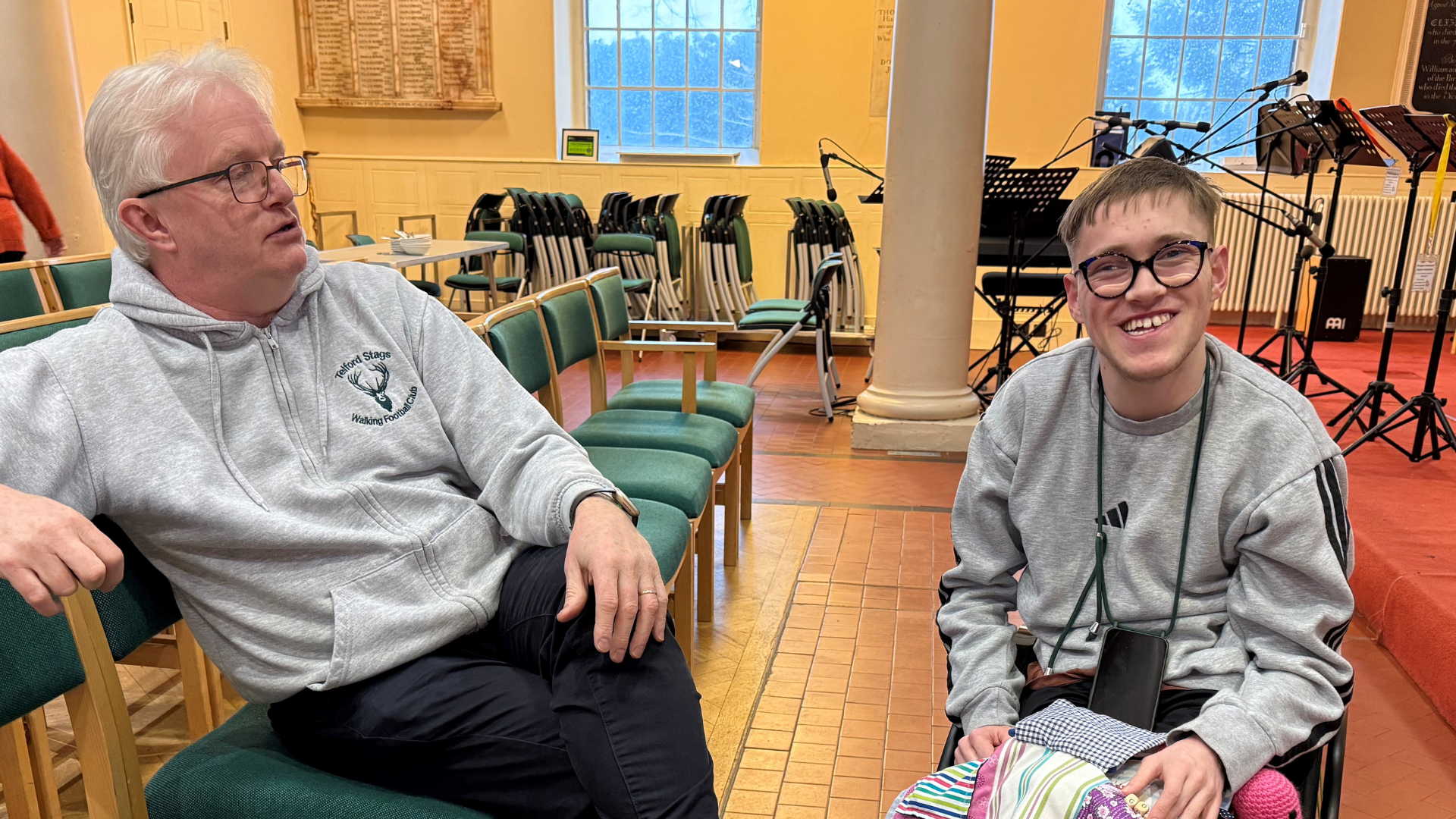
Collaboration brings benefits to congregation and its learning disabled members
For people with learning disabilities (LD), really being able to access church requires a thoughtful approach. A collaborative one is even better. In Madeley, Shropshire, 20-year old Jacob thinks it's been worth it - and so does the congregation! "I love coming to church," says Jacob. "It's one of my favourite things to do in the week." He continues, "The question is, what can people do to make services LD-friendly? A lot of the congregation are neurodivergent or have mental health issues and want to help out and get involved. I feel honoured to be a part of it."
Working with Count Everyone In, and using the resources and ingenuity of the congregation, including son Jacob, Rev'd Andy Ackroyd and other worship leaders have managed to further develop Café Church, a regular Service of the Word which feels welcoming and inclusive for LD members.
Says Rev’d Andy, “We already had some LD members when Andy arrived, but the service has managed to draw in new LD people from around the community, their families and friends, increasing the size of the overall congregation.” The fact that Rev’d Andy is Jacob's dad has made the process even more collaborative.
For physical disabilities, improving access and inclusion might mean putting in a ramp or a hearing loop, or making sure disabled people can fully participate in leading worship through roving microphones or lowering the lectern - things that might cost money and time, but once done, continue to deliver benefits. LD is different. It may mean changing liturgy and the way services are delivered. The good news is, help is at hand and the results may benefit everyone, not just the LD members of the congregation.
With support from Count Everyone In (CEI), a Christian charity aimed at full inclusion for the adult LD community, Rev’d Andy and other lay leaders have together designed their Café Church service to be accessible for LD Christians while feeling like worship in the fullest sense for the entire congregation. Rev’d Andy has also been collaborationg with St John’s, Muxton in Lichfield Diocese, “As well as our monthly cafe church, we are looking to work with St John’s to do a monthly 'Count me in' service entirely aimed at the adult LD community. That is in the pipeline. Muxton has already started bi-monthly and we are going to dovetail with them. They already have 20 families or so engaged and attending.”
Café Church at Madeley, every month, involves café-style seating at tables, with snacks, fidget toys, craft materials and musical instruments at each table. A puppeteer group presents scripture through music in an accessible style. The congregation joins in and does the actions. Words for familiar worship songs are projected on the big screen and worship leaders use a simple sign language called Makaton for some songs, to make the service really inclusive, helping LD people to participate. These songs are on the CEI website.
Jacob says, "We use simple words for the liturgy because it's harder for the congregation to understand more complicated words. The creed is the baptismal creed so we don't have to be able to read it. And at the end of each prayer we say a big, 'AAAAA-MEN' with arm actions."
The inclusive service format doesn't only benefit the 10 or so LD congregants and their carers. When we spoke with Rev’d Andy and Jacob, the flower team of Iris, June, Jeanette and Carol were busy bringing some spring colour into the church. Iris said, "We love Café Church, it's buzzing and lively. Most people stay for the simple lunch afterwards. The congregation has grown hugely since Rev’d Andy came a year ago. He is so active in the community, like a whirling dervish, reaching out to group homes and families with disabilities. Now when I go out into the town, I meet people from church all the time."
Iris continues, "People have learned that we are very tolerant of noise and people moving about during the service, so more families are coming with young children. Jacob is on the welcoming team and remembers everyone's names. They both bring so much of the Holy Spirit, with love and care for people, and it's spilling out into the community."
Jacob agrees, "We don't mind if children and young people make a bit of noise because that's what the service is all about, making a joyful noise to God. What works for LD people can also be good for young people and people with neurodivergence. Our twiddle mats, musical instruments and art materials help provide a sensory distraction if the words and music become overwhelming for people."
Rev Andy says communication with the church community has been key, "I told them that as we grow, church might feel more chaotic, so it has been important to bring them along on the journey. They are the most accepting church I've ever been in," he says, adding, "It's not everyone's cup of tea, and a few do not attend that service, but while a typical service would be 60-70 people, Café Church is 70-plus. Between all our services during the week, the congregation is now up over 100, from about 50 a year ago."
Iris agrees, "We don't worry anymore about all of us getting old and there being no one here to carry on!"
RESOURCES:
The Church of England has recently announced a £600,000 project to help make church more inclusive for children with addition needs.
Count Everyone In is a Christian charity which seeks to inspire and equip God’s church to be welcoming and accessible to all, especially those who are so often marginalised by society and even the church because of learning disability. “With a breadth of experience across denominations, church groups, ages and abilities, Count Everyone In wants to see all Christians mobilised to use the gifts God has given so that we all live life to the full, as God intended, and give that same invitation to life to those who might otherwise miss out.”
Makaton is a unique communication programme that uses symbols (pictures), signs (gestures) and speech to enable people to communicate. It supports the development of essential communication skills such as attention and listening, comprehension, memory, recall and organisation of language and expression. Makaton enables individuals to connect with other people and the world around them. This opens up all kinds of possibilities.
- ENDS -